Reviews

Shoebox review

For a very long time, the only reason I still used a Windows PC at home (apart from games, of course) was my reliance on IMatch. IMatch is a very powerful image cataloguing database program (a software category also known as Digital Asset Management), The thing that sets IMatch apart from most of its competition is its incredibly powerful category system, which essentially puts the full power of set theory at your fingertips.

Most other asset management programs either pay perfunctory attention to keywords, or require huge amounts of labor to set up, which is part of the cost of doing business for a stock photo agency, but not for an individual. The online photo sharing site Flickr popularized an equivalent system, tagging, which has the advantage of spanning multiple users (you will never be able to get many users to agree on a common classification schema for anything, tags are a reasonable compromise).

Unfortunately, IMatch is not available on the Mac. Canto Cumulus is cross-platform and has recently introduced something similar to IMatch’s categories, but it is expensive, and has an obscenely slow image import process (it took more than 30 hours to process 5000 or so photos from my collection on my dual-2GHz PowerMac G5 with 5.5GB of RAM!). Even Aperture is not that slow… I managed to kludge a transfer from IMatch to Cumulus using IMatch’s export functions and jury-rigging category import in Cumulus by reverse-engineering one of their data formats.

Cumulus is very clunky compared to IMatch (it does have the edge in some functions like client-server network capabilities for workgroups), and I had resigned myself to using it, until I stumbled upon Shoebox (thanks to Rui Carmo’s Tao of Mac). Shoebox (no relation to Kodak’s discontinued photo database bearing the same name) offers close to all the power of IMatch, with a much smoother and more usable interface to boot (IMatch is not particularly difficult if you limit yourself to its core functionality, but it does have a sometimes overwhelming array of menus and options).

screenshot

Andrew Zamler-Carhart, the programmer behind Shoebox, is very responsive to customer feedback, just like Mario Westphal, the author of IMatch — he actually implemented a Cumulus importer just for me, so moving to it was a snap (and much faster than the initial import into Cumulus). That in itself is a good sign that there will always be a place in the software world for the individual programmer, even in the world of “shrinkwrap software”, especially since the distribution efficiencies of the Internet have lowered the barrier to entry.

Shoebox is a Mac app through and through, with an attention to detail that shows. It makes excellent use of space, as on larger monitors like mine (click on the screen shot to see it at full resolution) or dual-monitor setups, and image categorization is both streamlined and productive. As an example, Shoebox fully supports using the keyboard to quickly classify images by typing the first few letters of a category name, with auto-completion, without requiring you to shift focus to a specific text box (this non-modal keyboard synergy is quite rare in the Macintosh world). It also has the ability to export categories to Spotlight keywords so your images can be searched by Spotlight. I won’t describe the user interface, since Kavasoft has an excellent guided tour.

No application is perfect, and there are a few minor issues or missing features. Shoebox does not know how to deal with XMP, limiting possible synergies with Adobe Photoshop and the many other applications that support XMP like the upcoming Lightroom. It would also benefit from improved RAW support – my Canon Digital Rebel XT CR2 thumbnails are not auto-rotated, for instance, but the blame for that probably lies with Apple. The application icon somehow invariably reminds me of In-n-Out burgers. The earlier versions of Shoebox had some stability problems when I first experimented with them, but the last two have been quite solid.

I haven’t started my own list of the top ten “must have” Macintosh applications, but Shoebox certainly makes the cut. If you are a Mac user and photographer, you owe it to yourself to try it and see how it can make your digital photo library emerge from chaos. I used to say IMatch was the best image database bar none, but nowadays I must add the qualification “for Windows”, and Shoebox is the new king across all platforms.
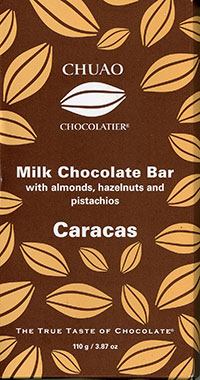
Chuao Chocolatier Caracas bar

CaracasI am partial to milk chocolate with high cocoa content. It combines the best of both worlds: the rich flavor of dark chocolate, and the smoothness of milk chocolate. The better grades will be made of cocoa coming from a single region, ideally Venezuelan criollo. The natural candidate would be El Rey, a Venezuelan maker, but I don’t like the milky aftertaste of their Caoba 41% cocoa bar. My favorite, Michel Cluizel, makes superlative bars with 50% cocoa content, but the cocoa is from Java or Madagascar. They even used to have a 60% bar blended with almond cream, unfortunately it seems to have been discontinued.

A new specialty chocolate store, Bittersweet Cafe, opened recently on Fillmore Street in san Francisco. They have a good selection, almost as good as Fog City News, with some brands I haven’t seen before. One of those was this bar made from Venezuelan Chuao criollo beans, with a mix of chopped almonds, hazelnuts, and interestingly, pistachios. It is made by Chuao Chocolatier, a small artisanal company based in San Diego (but we won’t hold their unfortunate choice of location against them).

The bar has a rich, deep flavor, and is not over-sweetened as is unfortunately too often the case with milk chocolates. The cocoa content is not indicated, but I would estimate it at around 40%. The nuts are crunchy and fresh, with no hint of rancidity. This is no small feat, hazelnuts and pistachios spoil easily and are tricky to work with. Fran’s, based in Seattle, won’t even ship some of their Oregon hazelnut confections outside Washington State out of fear they will lose their freshness by the time they arrive. At $6.50 ($6 if you buy direct in packs of 4), this is by no means cheap, but at least they give you an unusual 110 gram portion, none of that wimpy 75 gram size companies like Scharffen-Berger (now a part of the despicable Hershey group) are turning to in order to increase profits.

Merry Christmas to all, hopefully one rich in cacao…

Update (2012-12-13):

They changed the packaging and name. It is now called the “Milk chocolate nut nirvana”.

Update (2013-04-20):

Sadly Bittersweet Cafe’s Fillmore location is no more.

Wittgenstein’s Poker

The Story of a Ten-Minute Argument Between Two Great Philosophers

David Edmonds, John Eidinow

Harper Perennial, ISBN 0060936649, Publisher, Buy online

coverPlato is one of the sacred cows of the philosophy establishment. Whitehead famously wrote: “The safest general characterization of the European philosophical tradition is that it consists of a series of footnotes to Plato”. That said, his political theories are utterly indefensible. His attitude towards the Spartans who defeated and occupied his native Athens (and abolished the democracy the aristocratic Plato hated so much) would in modern terms be classified as that of a Quisling. His proposals are those of a soulmate of Pol Pot: a totalitarian society with a rigid caste system. In Plato’s ideal society, the philosopher-king caste rules through lies and deception1, children are removed from their parents to be brainwashed by the state, if they are allowed to survive the state’s eugenic culling of the weak in the first place. Dissidents are interned in reeducation camps and killed if they do not eventually recant. Given such moral bankruptcy, it is hard to take anything else he wrote seriously.
One wonders why Plato’s popularity among philosophers remains undimmed. Perhaps this has to do with vanity, as many a philosophy professor toiling in mediocrity no doubt fancies himself an unjustly overlooked candidate for the position of philosopher-king. As related by Plutarch, Plato himself, exiled from Athens by the restored democracy, sought to flatter Denys (Dionysius), the tyrant of Syracuse, by extolling the latter’s putative virtues as a philosopher, in order to induce him to follow the program exposed in The Republic. Denys demonstrated that even tyrants sometimes show wit2, dismissed Plato, and even considered enslaving the fawning philosopher so that he may experience a taste of what he advocated for others.

Another explanation may lie in Plato’s polemics against the Sophists. The Athenian democracy did not allow the use of lawyers in judicial proceedings, but the rich found a work-around: they hired specialists, essentially professors of rhetoric, to rehease trials. The Sophists would often boast that they could “prove” something and its opposite. This is a valuable, if somewhat debased skill, but it also has the side effect of destroying the credibility of philosophical methods, something Plato and his later admirers obviously object to. The Sophists were essentially skeptics and relativists, post-modernists over two millennia before post-modernism became fashionable. Plato’s was entirely successful in blackening their name, and the professional philosopher class no doubt owes some atavistic gratitude to him for that masterful propaganda.

Criticism of Plato’s views was mostly timid and limited to an audience of specialists, until Karl Popper revealed it for what it was in his blistering (and justifiably so) magnum opus of 1945, The Open Society and its Enemies: The Spell of Plato, although Bertrand Russell made pretty much the same points in his contemporary History of Western Philosophy. In his book, Popper exposes Plato as the wellspring for both Nazi and Communist totalitarism.

Popper was also a specialist in epistemology, the study of how knowledge is acquired, in science or elsewhere. His criterion of falsifiability (a theory is scientific only if it can be proven false), while not necessarily offering the practical guidance he hoped for, is still the best litmus test for whether a theory belongs to the realm of science (as in Darwin’s theory of Evolution) or not (as with creationism or its dissembling sibling, “Intelligent Design”).

As he believed in the worth of this endeavor, he had little patience for the hollow, superficial brilliance of a Ludwig Wittgenstein (I do not mean in any way to imply equivalence between Wittgenstein and a charlatan like, say, Derrida). Wittgenstein’s Poker retraces the background and history of the sole, explosive encounter between the two Austrians. Wittgenstein allegedly threatened Popper with a red hot fireplace poker, then stormed away in a huff. Debate still rages about exactly what happened, despite no dearth of witnesses, a testimony of sorts to the fallibility of human memory and the limits of the search for knowledge.

The book slowly and methodically lays the background behind the men’s confrontation. Both were born in assimilated Jewish families of Vienna, but the similarity ends there. Wittgenstein was the son of an immensely wealthy industrialist, and his brilliance was widely and immediately acknowledged by his peers. Popper’s middle-class family lost its savings in financial collapse, and he long had to struggle for both a living and recognition. The authors do a reasonably good job at explaining the philosophical differences between the two men in laymen’s terms. While both were refugees from the Nazis, the book’s insistence on their Jewish background as a major factor on their outlook seems a stretch.

After all this preparatory work, the description of the argument itself is a let-down. It is rather hurried, and makes too many unwarranted assumptions on the psychological state of mind of the protagonists, bordering on a fictionalized account.

1: Interestingly, this concept of the “noble lie” was revived by the so-called neo-cons, many of whom are followers of Leo Strauss, an admirer of Plato. This only goes to show the enduring relevance of Popper’s Open Society.

2: In another instance, Argentina’s Juan Perón “promoted” his critic Jorge Luis Borges to inspector for poultry and rabbits at the Buenos Aires municipal market. Borges reacted with vitriol, but his later approbation of the 1976 junta puts the lie to any grandiose claims of principle.

Michael Recchiuti Hazelnut Praline

The dukes of Praslin-Choiseul stem from one of the most illustrious noble families in France, but they are best known because one of their pastry chefs invented the confection known as praliné in honor of his patron. Brillat-Savarin famously wrote “the invention of a new dish does more for the happiness of mankind than the discovery of a new star”. Apparently it does wonders for a family’s name recognition as well.

Praliné is basically a blend of finely ground hazelnuts and almonds and cooked with boiling sugar (otherwise, it would just be another form of marzipan). If it is mixed with chocolate, it becoms gianduja. If the nut fragments remain discernable in a matrix of caramelized sugar, the result is nougatine, one of the heights of French pastry-making. One interesting variety is feuilleté praliné, where the praliné is blended with pieces of extremely fine and crisp wafers to yield a confection that has at once the smoothness of praliné and the crispiness of a flaky pastry. When I was a kid, I would often buy “Lutti Noisettor”, a hard hazelnut-flavored candy where the core had this same stratified laminated and crunchy texture, but it seems it has been discontinued, perhaps the fabrication technique was too complex to be profitable.

Michael Recchiuti is a chocolatier who moved to the San Francisco about a decade ago to start his confectionery business with his wife Jacky. He has a boutique in the Ferry Building food court and a number of the better groceries in the city carry his products. A small operation like his cannot make its own chocolate couverture, and it appears he relies on Guittard, another reputable San Francisco company. In addition to his lovely chocolate bouchées, Recchiuti makes a line of chocolate tablets.

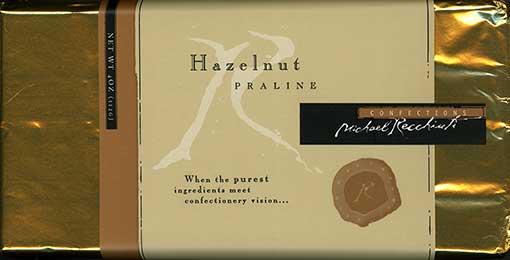
Recchiuti Hazelnut Praline wrapper

My favorite one is the Hazelnut Praline, which is actually a feuilleté praliné. A safety disclaimer ought to be mandatory on the wrapper, as biting into a piece is an amazingly intense experience. The couverture is excellent, but it is the praliné that grabs your attention: rich, dark, clearly made with a high proprtion of nuts to sugar and blended with dark rather than milk chocolate, and with the delightful crispy texture of feuilletine. Everyone I gave a taste of this bar had the same reaction of utter amazement, it is that good.

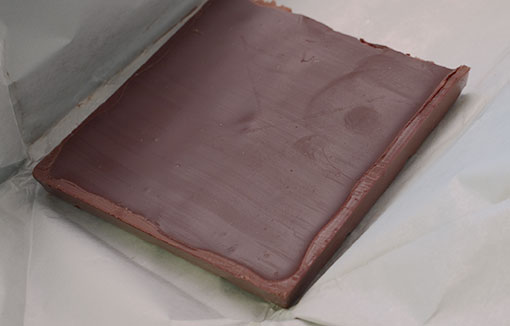
Hazelnut Praline detail

The chocolate bar is clearly made by hand, as you can see from the irregular shape on the other side of the mold. This is unfortunate in a way, as it means distribution will remain limited for the foreseeable future. I have worked it into my standard tour of San Francisco for visiting friends and relatives, as they are unlikely to experience it elsewhere.

Update (2006-11-24):

All good things come to pass, and this product has been discontinued. The other Recchuti bars seem uninspiring.

Chocovic Ocumare

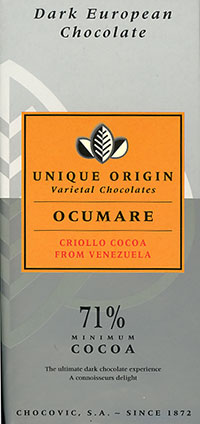
OcumareThe world’s best chocolate comes from the criollo variety of Venezuela, renowned for its complex and subtle flavor. Unfortunately, this variety, the original and purest variant of cacao, is fragile and has poor yields, making it expensive to produce. That’s why bars like Amedei Porcelana sell for more than $10 per tablet.

Fortunately, there are inexpensive alternatives. For those who live near that great South California institution, Trader Joe’s, run, don’t walk, to stock up on Chocovic Ocumare, which retails for a mere $1.79 a bar. Chocovic is based in Barcelona, and has a line of single-origin Southern American chocolates named in honor of their places of origin (Ocumare is a coastal cacao-growing district of Aragua state in Venezuela). Few people immediately associate Spain with chocolate, but the Spaniards are the ones who first imported the cocoa bean to Europe, and Spain obviously maintains a close relationship with Latin American nations which produce the best cacao (unlike the more industrial but lower grade stuff that comes from Ghana/Ivory Coast and South-East Asia).

As with all criollos, the Ocumare is relatively mild but has a very rich taste that lingers in the mouth. It may seem like sacrilege to use it for cooking, but when made into a ganache and poured as a frosting over a cake, it is simply phenomenal. Just make sure the cake in question is exceptional enough to deserve this truly regal treatment…